Kenyon College Commencement, May 20, 1990
Speaker: Bill Watterson
I have a recurring dream about Kenyon. In it, I'm walking to the post office on the way to my first class at the start of the school year. Suddenly it occurs to me that I don't have my schedule memorized, and I'm not sure which classes I'm taking, or where exactly I'm supposed to be going. As I walk up the steps to the post office, I realize I don't have my box key, and in fact, I can't remember what my box number is. I'm certain that everyone I know has written me a letter, but I can't get them. I get more flustered and annoyed by the minute. I head back to Middle Path, racking my brains and asking myself, "How many more years until I graduate? Wait, didn't I graduate already? How old AM I?" Then I wake up.
Experience is food for the brain. And four years at Kenyon is a rich meal. I suppose it should be no surprise that your brains will probably burp up Kenyon for a long time. And I think the reason I keep having the dream is because its central image is a metaphor for a good part of life: that is, not knowing where you're going or what you're doing.
I graduated exactly ten years ago. That doesn't give me a great deal of experience to speak from, but I'm emboldened by the fact that I can't remember a bit of MY commencement, and I trust that in half an hour, you won't remember of yours either.
In the middle of my sophomore year at Kenyon, I decided to paint a copy of Michelangelo's "Creation of Adam" from the Sistine Chapel on the ceiling of my dorm room. By standing on a chair, I could reach the ceiling, and I taped off a section, made a grid, and started to copy the picture from my art history book. Working with your arm over your head is hard work, so a few of my more ingenious friends rigged up a scaffold for me by stacking two chairs on my bed, and laying the table from the hall lounge across the chairs and over to the top of my closet. By climbing up onto my bed and up the chairs, I could hoist myself onto the table, and lie in relative comfort two feet under my painting. My roommate would then hand up my paints, and I could work for several hours at a stretch. The picture took me months to do, and in fact, I didn't finish the work until very near the end of the school year. I wasn't much of a painter then, but what the work lacked in color sense and technical flourish, it gained in the incongruity of having a High Renaissance masterpiece in a college dorm that had the unmistakable odor of old beer cans and older laundry. The painting lent an air of cosmic grandeur to my room, and it seemed to put life into a larger perspective. Those boring, flowery English poets didn't seem quite so important, when right above my head God was transmitting the spark of life to man.
My friends and I liked the finished painting so much in fact, that we decided I should ask permission to do it. As you might expect, the housing director was curious to know why I wanted to paint this elaborate picture on my ceiling a few weeks before school let out. Well, you don't get to be a sophomore at Kenyon without learning how to fabricate ideas you never had, but I guess it was obvious that my idea was being proposed retroactively. It ended up that I was allowed to paint the picture, so long as I painted over it and returned the ceiling to normal at the end of the year. And that's what I did. Despite the futility of the whole episode, my fondest memories of college are times like these, where things were done out of some inexplicable inner imperative, rather than because the work was demanded. Clearly, I never spent as much time or work on any authorized art project, or any poli-sci paper, as I spent on this one act of vandalism.
It's surprising how hard we'll work when the work is done just for ourselves. And with all due respect to John Stuart Mill, maybe utilitarianism is overrated. If I've learned one thing from being a cartoonist, it's how important playing is to creativity and happiness. My job is essentially to come up with 365 ideas a year. If you ever want to find out just how uninteresting you really are, get a job where the quality and frequency of your thoughts determine your livelihood. I've found that the only way I can keep writing every day, year after year, is to let my mind wander into new territories. To do that, I've had to cultivate a kind of mental playfulness.
We're not really taught how to recreate constructively. We need to do more than find diversions; we need to restore and expand ourselves. Our idea of relaxing is all too often to plop down in front of the television set and let its pandering idiocy liquefy our brains. Shutting off the thought process is not rejuvenating; the mind is like a car battery- it recharges by running.
You may be surprised to find how quickly daily routine and the demands of “just getting by” absorb your waking hours. You may be surprised to find how quickly you start to see your politics and religion become matters of habit rather than thought and inquiry. You may be surprised to find how quickly you start to see your life in terms of other people's expectations rather than issues. You may be surprised to find out how quickly reading a good book sounds like a luxury.
At school, new ideas are thrust at you every day. Out in the world, you'll have to find the inner motivation to search for new ideas on your own. With any luck at all, you'll never need to take an idea and squeeze a punchline out of it, but as bright, creative people, you'll be called upon to generate ideas and solutions all your lives. Letting your mind play is the best way to solve problems. For me, it's been liberating to put myself in the mind of a fictitious six year-old each day, and rediscover my own curiosity. I've been amazed at how one ideas leads to others if I allow my mind to play and wander. I know a lot about dinosaurs now, and the information has helped me out of quite a few deadlines.
A playful mind is inquisitive, and learning is fun. If you indulge your natural curiosity and retain a sense of fun in new experience, I think you'll find it functions as a sort of shock absorber for the bumpy road ahead.
So, what's it like in the real world? Well, the food is better, but beyond that, I don't recommend it. I don't look back on my first few years out of school with much affection, and if I could have talked to you six months ago, I'd have encouraged you all to flunk some classes and postpone this moment as long as possible. But now it's too late. Unfortunately, that was all the advice I really had. When I was sitting where you are, I was one of the lucky few who had a cushy job waiting for me. I'd drawn political cartoons for the Collegian for four years, and the Cincinnati Post had hired me as an editorial cartoonist. All my friends were either dreading the infamous first year of law school, or despondent about their chances of convincing anyone that a history degree had any real application outside of academia.
Boy, was I smug.
As it turned out, my editor instantly regretted his decision to hire me. By the end of the summer, I'd been given notice; by the beginning of winter, I was in an unemployment line; and by the end of my first year away from Kenyon, I was broke and living with my parents again. You can imagine how upset my dad was when he learned that Kenyon doesn't give refunds.
Watching my career explode on the lauchpad caused some soul searching. I eventually admitted that I didn't have what it takes to be a good political cartoonist, that is, an interest in politics, and I returned to my firs love, comic strips. For years I got nothing but rejection letters, and I was forced to accept a real job. A REAL job is a job you hate. I designed car ads and grocery ads in the windowless basement of a convenience store, and I hated every single minute of the 4-1/2 million minutes I worked there. My fellow prisoners at work were basically concerned about how to punch the time clock at the perfect second where they would earn another 20 cents without doing any work for it. It was incredible: after every break, the entire staff would stand around in the garage where the time clock was, and wait for that last click. And after my used car needed the head gasket replaced twice, I waited in the garage too.
It's funny how at Kenyon, you take for granted that the people around you think about more than the last episode of Dynasty. I guess that's what it means to be in an ivory tower.
Anyway, after a few months at this job, I was starved for some life of the mind that, during my lunch break, I used to read those poli-sci books that I'd somehow never quite finished when I was here. Some of those books were actually kind of interesting. It was a rude shock to see just how empty and robotic life can be when you don't care about what you're doing, and the only reason you're there is to pay the bills. Thoreau said, "The mass of men lead lives of quiet desperation." That's one of those dumb cocktail quotations that will strike fear in your heart as you get older. Actually, I was leading a life of loud desperation.
When it seemed I would be writing about "Midnite Madness Sale-abrations" for the rest of my life, a friend used to console me that cream always rises to the top. I used to think, so do people who throw themselves into the sea.
I tell you all this because it's worth recognizing that there is no such thing as an overnight success. You will do well to cultivate the resources in yourself that bring you happiness outside of success or failure. The truth is, most of us discover where we are headed when we arrive. At that time, we turn around and say, yes, this is obviously where I was going all along. It's a good idea to try to enjoy the scenery on the detours, because you'll probably take a few.
I still haven't drawn the strip as long as it took me to get the job. To endure five years of rejection to get a job requires either a faith in oneself that borders on delusion, or a love of the work. I loved the work.
Drawing comic strips for five years without pay drove home the point that the fun of cartooning wasn't in the money; it was in the work. This turned out to be an important realization when my break finally came.
Like many people, I found that what I was chasing wasn't what I caught. I've wanted to be a cartoonist since I was old enough to read cartoons, and I never really thought about cartoons as being a business. It never occurred to me that a comic strip I created would be at the mercy of a bloodsucking corporate parasite called a syndicate, and that I'd be faced with countless ethical decisions masquerading as simple business decisions. To make a business decision, you don't need much philosophy; all you need is greed, and maybe a little knowledge of how the game works.
As my comic strip became popular, the pressure to capitalize on that popularity increased to the point where I was spending almost as much time screaming at executives as drawing. Cartoon merchandising is a $12 billion dollar a year industry and the syndicate understandably wanted apiece of that pie. But the more I though about what they wanted to do with my creation, the more inconsistent it seemed with the reasons I draw cartoons. Selling out is usually more a matter of buying in. Sell out, and you're really buying into someone else's system of values, rules and rewards.
The so-called "opportunity" I faced would have meant giving up my individual voice for that of a money-grubbing corporation. It would have meant my purpose in writing was to sell things, not say things. My pride in craft would be sacrificed to the efficiency of mass production and the work of assistants. Authorship would become committee decision. Creativity would become work for pay. Art would turn into commerce. In short, money was supposed to supply all the meaning I'd need. What the syndicate wanted to do, in other words, was turn my comic strip into everything calculated, empty and robotic that I hated about my old job. They would turn my characters into television hucksters and T-shirt sloganeers and deprive me of characters that actually expressed my own thoughts. On those terms, I found the offer easy to refuse. Unfortunately, the syndicate also found my refusal easy to refuse, and we've been fighting for over three years now. Such is American business, I guess, where the desire for obscene profit mutes any discussion of conscience.
You will find your own ethical dilemmas in all parts of your lives, both personal and professional. We all have different desires and needs, but if we don't discover what we want from ourselves and what we stand for, we will live passively and unfulfilled. Sooner or later, we are all asked to compromise ourselves and the things we care about. We define ourselves by our actions. With each decision, we tell ourselves and the world who we are. Think about what you want out of this life, and recognize that there are many kinds of success.
Many of you will be going on to law school, business school, medical school, or other graduate work, and you can expect the kind of starting salary that, with luck, will allow you to pay off your own tuition debts within your own lifetime. But having an enviable career is one thing, and being a happy person is another.
Creating a life that reflects your values and satisfies your soul is a rare achievement. In a culture that relentlessly promotes avarice and excess as the good life, a person happy doing his own work is usually considered an eccentric, if not a subversive. Ambition is only understood if it's to rise to the top of some imaginary ladder of success. Someone who takes an undemanding job because it affords him the time to pursue other interests and activities is considered a flake. A person who abandons a career in order to stay home and raise children is considered not to be living up to his potential-as if a job title and salary are the sole measure of human worth. You'll be told in a hundred ways, some subtle and some not, to keep climbing, and never be satisfied with where you are, who you are, and what you're doing. There are a million ways to sell yourself out, and I guarantee you'll hear about them. To invent your own life's meaning is not easy, but it's still allowed, and I think you'll be happier for the trouble.
Reading those turgid philosophers here in these remote stone buildings may not get you a job, but if those books have forced you to ask yourself questions about what makes life truthful, purposeful, meaningful, and redeeming, you have the Swiss Army Knife of mental tools, and it's going to come in handy all the time. I think you'll find that Kenyon touched a deep part of you. These have been formative years. Chances are, at least of your roommates has taught you everything ugly about human nature you ever wanted to know. With luck, you've also had a class that transmitted a spark of insight or interest you'd never had before. Cultivate that interest, and you may find a deeper meaning in your life that feeds your soul and spirit. Your preparation for the real world is not in the answers you've learned, but in the questions you've learned how to ask yourself.
Graduating from Kenyon, I suspect you'll find yourselves quite well prepared indeed. I wish you all fulfillment and happiness. Congratulations on your achievement.
Thursday, June 5, 2014


Monday, May 26, 2014
Top Ten Mistakes for Americans to Avoid While Watching the World Cup
10. “He totally touched that! Handball!”
First, a handball doesn’t just refer to a ball touching a hand, but the arm and shoulder as well. It is not illegal for a ball to hit a player on the hand, arm or shoulder. It is illegal for a player to deliberately use their hand, arm or shoulder. Further, a player must use reasonable effort to avoid touching a ball with a hand, arm or shoulder. So if a ball is kicked and immediately hits an opponent’s arm before he has time to react, it is not a handball, as long as that player’s arm wasn’t in an unnatural position at the time. One player on each team is allowed an exception to this rule, and that player can use his hands and arms only while within his own 18 yard box, often called the penalty area.
9. “That goalie’s clothes are crazy!”
The player allowed to handle the ball within his penalty area is referred to as the “goalkeeper.” Every sport has its own jargon, and football jargon is often unique. It is best to avoid calling the goalkeeper a goalie, and he's definitely not a goaltender. Why does it matter? Maybe it doesn't. Throughout most of the world, even calling the sport "soccer" is considered an insult, but in America, that's what we call it, even while realizing it is properly called "football." Since I'm in America, I tend to call it soccer just so other Americans know what sport I'm talking about, but would never call it soccer when speaking with someone from another country.
Second, and back to the point, footballers do not wear clothes, they wear a kit. The goalkeeper is required to wear a distinctive kit in order to be easily identifiable by the referee, and so wearing loud colors is encouraged. (Other jargon words to know: the field is called the “pitch;” a game is called a “match.”)
8. “That wasn’t a tackle- he didn’t even fall!”
A “challenge” refers to two players simultaneously vying for the ball, and tackling is one way a player can attempt to win a challenge. In soccer, this is what an attempted tackle looks like:

This is what a successful tackle looks like:

This is what a type of tackle called a slide tackle looks like:

The previous tackles are legal even if incidental contact with an opponent is made. Here are some examples of tackles that are illegal if contact with an opponent is made:
(Cleats facing opponent)

(Two-legged)

(From behind or through opponent, making contact with opponent first)

(Too late)

You also can’t adjust your body position in order to get in the way of or trip an opposing player after a successful tackle.
Here is an actual example of a world-class tackle:

This is an excellent slide tackle:

7. “Offsides!”
It’s “offside;” there is no “s!” I once yelled this at a person rooting for the opposing team during a particularly intense match. I sort of feel bad about it, but unlike with some previously-mentioned jargon, this one is unforgivable. Look it up: it’s Law 11. A player on the opponent’s half of the pitch is ineligible to receive a forward pass from a teammate if there are not two defenders nearer to the opponent’s goal line than any part of his body that can receive the pass at the time of the pass. There is no offside during a throw-in, goal kick or corner kick, although that last one should be obvious. Note the goal line is the entire line that connects the side lines, not only the section between the crossbars. That’s all there is to it, but it effects every dimension of the sport.
In short, the offside rule means you have to outwit and not just outrun at least one opponent other than the goalkeeper.
6. “This sport is so slow!”
On the contrary, one of the best things about soccer is its extremely fast pace. Only the referee can stop the action, and keeps track of when he does in order to add that down time to the end of each period. The players must strategize, act and react on the fly, simultaneously playing offense and defense while covering an area slightly longer and significantly wider than an American football field. Right now, Real Madrid from Spain is the fastest and most athletically fit team in the world. There is no group of players in any sport short of auto racing that could keep up with their pace for a full 90 minutes. Matches in which a winner must be decided sometimes go into extra time, conceptually the same as overtime, and these are often brutal affairs in which players fight fatigue and cramping muscles after having already given their all in the first two halves.
Because the only time most Americans even know soccer is being played is during the World Cup, many Americans don’t realize that players spend very little time training and playing with their national team. In every country, including America, national teams are made up of a sort of “all-star” collection of players from various teams, properly called “clubs.” Club matches are what most of the rest of the world follows for nine months of every year, and the athletes dedicate the vast majority of their time and attention to playing with their club in a style reflecting the strategic philosophy of that club, which may be very different than the style of their national team. Consequently, some World Cup teams will inevitably be slow, sloppy and error-ridden. The amazing thing about World Cup is that the overwhelming fan support and national pride will drive some players and teams to rise above all limitations and excel beyond all expectations.
To some degree, watching soccer is like watching a chess match where every move is immediately made with no time to think. If that doesn’t sound exciting, I'd recommend watching inner-city sidewalk chess matches. Every moment of the uninterrupted action could become crucial, and the discipline required, especially of the players but also the fans, to maintain focus for 45 minutes is not something a lot of Americans possess. I honestly believe Americans perceive soccer as slow because there are no commercials to entertain them.
5. “They should allow more substitutes.”
Soccer is a test of both speed and endurance. In competitive matches, only three player substitutions are allowed for any reason, including injury. Substituting for healthy players is a calculated risk willingly made by the manager. If all three subs have been made and a player gets injured, the thing to be questioned isn’t whether the rules should be changed, but whether the manager goofed.
Playing with fewer players than your opponent is part of the game, and another way in which soccer resembles chess. The main three ways a team is required to be short a player for the remainder of the match are violent conduct, if a player is deemed to have committed two fouls on purpose during the course of a match or if a player's foul prevents a clear goal-scoring opportunity. A player is "sent off" by being shown a red card.
There are non-tournament matches, called “friendlies,” in which more than three substitutes are allowed. These are akin to baseball spring-training games, with less focus on team interaction and more of a try-out for individuals to impress their manager. Counter-intuitively, allowing more substitutions slows the game down.
4. “It’s so boring they rarely score.”
The difficulty of scoring a goal adds to, not detracts from, the excitement. Watching the highlights of a match simply does not do the sport justice, because it removes the context. The drama lies in the nuances involved in protecting one goal while attacking the other.
There’s an episode of Star Trek: Next Generation, called “Peak Performance,” where Data frustrates a master strategist into giving up at a computerized strategy game called Strategema, much to the delight of the Enterprise crew. When asked how he did it, Data reveals that his strategy was not to win, but to stalemate. As a matter of fact, in point-based soccer matches, a winner receives three points and the loser zero, but in the case of a draw, each team gets one point. Therefore, if a team only needs one point and/or are playing a better team, they will often implement the same strategy as television’s pre-eminent sci-fi android. Trying to beat a team willing to draw is one example of the intensity within the sport that remains hidden from the novice viewer.
3. “It’s a sissy sport in which everybody is always pretending to be hurt.”
It’s telling that after expounding on ways in which the sport should be made easier, critics will declare it to be too easy. I’ve noticed a universal tendency to dismiss any sport one is unfamiliar with as being both weak and unsophisticated. For example, last year my girlfriend and I attended a single-A baseball game that included a player from Germany. This piqued my girlfriend’s interest, as she grew up in Germany and knows there is no baseball there, so she looked him up and found an article about him from a German paper. The comments after the article consisted of Germans trying to figure out what baseball was. After discovering via the German version of Wikipedia that it consisted largely of someone hitting a ball with a stick and then running around in a large circle as fast as possible, they agreed it was a sport with no strategy best suited for girls.
The only padding soccer players wear are shin guards, even though they have both skulls and cleats flying at them on a fairly regular basis. Getting kicked by a person who makes his profession by kicking cannot feel good. Because of the limited substitutions, players are sometimes obliged to play through injuries. A player with a cracked head with wrap enough gauze around it to absorb the bleeding as fast as he can- because his team will continue short a player while he is being tended to- and get right back into the action. Injury is inevitable in modern football, especially when one considers that the average footballer will play in over 50 matches each year.
One element of soccer that can get really annoying is “diving,” or “flopping.” This is a strategy employed by some, but not most, footballers, that consists of a player pretending he’s been fouled by falling to the ground and then often rolling around on the ground like a shot animal. Some footballers will make a drama out of demonstrating that they could have been injured in an attempt to protect themselves from the possibility of actually being injured on a similar play in the future. Another reason for flopping is due to the “advantage” rule. If a player is fouled, a referee will let play continue if he deems it advantageous for the fouled team to do so. A player who has been fouled will fall down in order to reduce the possibility of a referee declaring an advantage if that player would rather be awarded a free kick. Although flopping is considered dissent and should be punished with a yellow card, it rarely is, simply because it is often very difficult to determine whether they’re actually faking it.
2. “I just don’t understand it.”
Part of the beauty of soccer is its simplicity. There are only 19 rules, known as laws, the most complicated of which is probably the offside rule, which I summarized in one sentence. Another main thing to understand is that fouls are divided into two types; those awarded with a direct free kick and those awarded with an indirect free kick. The latter type requires a pass to be made. All free kicks are taken from the location of the foul (not where the ball was during the foul, except fouls of the direct free kick type drawn within the 18 yard box, whick can be awarded with a one-on-one penalty kick.
Most fouls stress the importance of not slowing the game and playing the ball and not the opponent. (Setting screens, for example is an indirect free kick foul.) If either type of foul is deemed to be intentional or shows disregard for the rules or referees (and not just the result of poor execution), the guilty player is given a warning in the form of a yellow card.
Most of the rest of it you can intuit from watching a couple matches. The complete, fully-illustrated rulebook can be found here: pdf of fifa football laws
American culture is ingrained with the concept that anything they are ignorant of is not worth knowing about. The majority of Americans are not explorers; they instead prefer to assume there is nothing greater than the things they are familiar with. Brand loyalty has proven lucrative for those selling it, but not particularly healthy for the consumers.
1. “American football is better because…”
As there are virtually no similarities between Association football, aka soccer, and American football, comparing the two is pointless. American football is a slower, tamer version of rugby, and there is only one country in the world that pays any attention to it.
First, a handball doesn’t just refer to a ball touching a hand, but the arm and shoulder as well. It is not illegal for a ball to hit a player on the hand, arm or shoulder. It is illegal for a player to deliberately use their hand, arm or shoulder. Further, a player must use reasonable effort to avoid touching a ball with a hand, arm or shoulder. So if a ball is kicked and immediately hits an opponent’s arm before he has time to react, it is not a handball, as long as that player’s arm wasn’t in an unnatural position at the time. One player on each team is allowed an exception to this rule, and that player can use his hands and arms only while within his own 18 yard box, often called the penalty area.
9. “That goalie’s clothes are crazy!”
The player allowed to handle the ball within his penalty area is referred to as the “goalkeeper.” Every sport has its own jargon, and football jargon is often unique. It is best to avoid calling the goalkeeper a goalie, and he's definitely not a goaltender. Why does it matter? Maybe it doesn't. Throughout most of the world, even calling the sport "soccer" is considered an insult, but in America, that's what we call it, even while realizing it is properly called "football." Since I'm in America, I tend to call it soccer just so other Americans know what sport I'm talking about, but would never call it soccer when speaking with someone from another country.
Second, and back to the point, footballers do not wear clothes, they wear a kit. The goalkeeper is required to wear a distinctive kit in order to be easily identifiable by the referee, and so wearing loud colors is encouraged. (Other jargon words to know: the field is called the “pitch;” a game is called a “match.”)
8. “That wasn’t a tackle- he didn’t even fall!”
A “challenge” refers to two players simultaneously vying for the ball, and tackling is one way a player can attempt to win a challenge. In soccer, this is what an attempted tackle looks like:

This is what a successful tackle looks like:

This is what a type of tackle called a slide tackle looks like:

The previous tackles are legal even if incidental contact with an opponent is made. Here are some examples of tackles that are illegal if contact with an opponent is made:
(Cleats facing opponent)

(Two-legged)

(From behind or through opponent, making contact with opponent first)

(Too late)

You also can’t adjust your body position in order to get in the way of or trip an opposing player after a successful tackle.
Here is an actual example of a world-class tackle:

This is an excellent slide tackle:

7. “Offsides!”
It’s “offside;” there is no “s!” I once yelled this at a person rooting for the opposing team during a particularly intense match. I sort of feel bad about it, but unlike with some previously-mentioned jargon, this one is unforgivable. Look it up: it’s Law 11. A player on the opponent’s half of the pitch is ineligible to receive a forward pass from a teammate if there are not two defenders nearer to the opponent’s goal line than any part of his body that can receive the pass at the time of the pass. There is no offside during a throw-in, goal kick or corner kick, although that last one should be obvious. Note the goal line is the entire line that connects the side lines, not only the section between the crossbars. That’s all there is to it, but it effects every dimension of the sport.
In short, the offside rule means you have to outwit and not just outrun at least one opponent other than the goalkeeper.
6. “This sport is so slow!”
On the contrary, one of the best things about soccer is its extremely fast pace. Only the referee can stop the action, and keeps track of when he does in order to add that down time to the end of each period. The players must strategize, act and react on the fly, simultaneously playing offense and defense while covering an area slightly longer and significantly wider than an American football field. Right now, Real Madrid from Spain is the fastest and most athletically fit team in the world. There is no group of players in any sport short of auto racing that could keep up with their pace for a full 90 minutes. Matches in which a winner must be decided sometimes go into extra time, conceptually the same as overtime, and these are often brutal affairs in which players fight fatigue and cramping muscles after having already given their all in the first two halves.
Because the only time most Americans even know soccer is being played is during the World Cup, many Americans don’t realize that players spend very little time training and playing with their national team. In every country, including America, national teams are made up of a sort of “all-star” collection of players from various teams, properly called “clubs.” Club matches are what most of the rest of the world follows for nine months of every year, and the athletes dedicate the vast majority of their time and attention to playing with their club in a style reflecting the strategic philosophy of that club, which may be very different than the style of their national team. Consequently, some World Cup teams will inevitably be slow, sloppy and error-ridden. The amazing thing about World Cup is that the overwhelming fan support and national pride will drive some players and teams to rise above all limitations and excel beyond all expectations.
To some degree, watching soccer is like watching a chess match where every move is immediately made with no time to think. If that doesn’t sound exciting, I'd recommend watching inner-city sidewalk chess matches. Every moment of the uninterrupted action could become crucial, and the discipline required, especially of the players but also the fans, to maintain focus for 45 minutes is not something a lot of Americans possess. I honestly believe Americans perceive soccer as slow because there are no commercials to entertain them.
5. “They should allow more substitutes.”
Soccer is a test of both speed and endurance. In competitive matches, only three player substitutions are allowed for any reason, including injury. Substituting for healthy players is a calculated risk willingly made by the manager. If all three subs have been made and a player gets injured, the thing to be questioned isn’t whether the rules should be changed, but whether the manager goofed.
Playing with fewer players than your opponent is part of the game, and another way in which soccer resembles chess. The main three ways a team is required to be short a player for the remainder of the match are violent conduct, if a player is deemed to have committed two fouls on purpose during the course of a match or if a player's foul prevents a clear goal-scoring opportunity. A player is "sent off" by being shown a red card.
There are non-tournament matches, called “friendlies,” in which more than three substitutes are allowed. These are akin to baseball spring-training games, with less focus on team interaction and more of a try-out for individuals to impress their manager. Counter-intuitively, allowing more substitutions slows the game down.
4. “It’s so boring they rarely score.”
The difficulty of scoring a goal adds to, not detracts from, the excitement. Watching the highlights of a match simply does not do the sport justice, because it removes the context. The drama lies in the nuances involved in protecting one goal while attacking the other.
There’s an episode of Star Trek: Next Generation, called “Peak Performance,” where Data frustrates a master strategist into giving up at a computerized strategy game called Strategema, much to the delight of the Enterprise crew. When asked how he did it, Data reveals that his strategy was not to win, but to stalemate. As a matter of fact, in point-based soccer matches, a winner receives three points and the loser zero, but in the case of a draw, each team gets one point. Therefore, if a team only needs one point and/or are playing a better team, they will often implement the same strategy as television’s pre-eminent sci-fi android. Trying to beat a team willing to draw is one example of the intensity within the sport that remains hidden from the novice viewer.
3. “It’s a sissy sport in which everybody is always pretending to be hurt.”
It’s telling that after expounding on ways in which the sport should be made easier, critics will declare it to be too easy. I’ve noticed a universal tendency to dismiss any sport one is unfamiliar with as being both weak and unsophisticated. For example, last year my girlfriend and I attended a single-A baseball game that included a player from Germany. This piqued my girlfriend’s interest, as she grew up in Germany and knows there is no baseball there, so she looked him up and found an article about him from a German paper. The comments after the article consisted of Germans trying to figure out what baseball was. After discovering via the German version of Wikipedia that it consisted largely of someone hitting a ball with a stick and then running around in a large circle as fast as possible, they agreed it was a sport with no strategy best suited for girls.
The only padding soccer players wear are shin guards, even though they have both skulls and cleats flying at them on a fairly regular basis. Getting kicked by a person who makes his profession by kicking cannot feel good. Because of the limited substitutions, players are sometimes obliged to play through injuries. A player with a cracked head with wrap enough gauze around it to absorb the bleeding as fast as he can- because his team will continue short a player while he is being tended to- and get right back into the action. Injury is inevitable in modern football, especially when one considers that the average footballer will play in over 50 matches each year.
One element of soccer that can get really annoying is “diving,” or “flopping.” This is a strategy employed by some, but not most, footballers, that consists of a player pretending he’s been fouled by falling to the ground and then often rolling around on the ground like a shot animal. Some footballers will make a drama out of demonstrating that they could have been injured in an attempt to protect themselves from the possibility of actually being injured on a similar play in the future. Another reason for flopping is due to the “advantage” rule. If a player is fouled, a referee will let play continue if he deems it advantageous for the fouled team to do so. A player who has been fouled will fall down in order to reduce the possibility of a referee declaring an advantage if that player would rather be awarded a free kick. Although flopping is considered dissent and should be punished with a yellow card, it rarely is, simply because it is often very difficult to determine whether they’re actually faking it.
2. “I just don’t understand it.”
Part of the beauty of soccer is its simplicity. There are only 19 rules, known as laws, the most complicated of which is probably the offside rule, which I summarized in one sentence. Another main thing to understand is that fouls are divided into two types; those awarded with a direct free kick and those awarded with an indirect free kick. The latter type requires a pass to be made. All free kicks are taken from the location of the foul (not where the ball was during the foul, except fouls of the direct free kick type drawn within the 18 yard box, whick can be awarded with a one-on-one penalty kick.
Most fouls stress the importance of not slowing the game and playing the ball and not the opponent. (Setting screens, for example is an indirect free kick foul.) If either type of foul is deemed to be intentional or shows disregard for the rules or referees (and not just the result of poor execution), the guilty player is given a warning in the form of a yellow card.
Most of the rest of it you can intuit from watching a couple matches. The complete, fully-illustrated rulebook can be found here: pdf of fifa football laws
American culture is ingrained with the concept that anything they are ignorant of is not worth knowing about. The majority of Americans are not explorers; they instead prefer to assume there is nothing greater than the things they are familiar with. Brand loyalty has proven lucrative for those selling it, but not particularly healthy for the consumers.
1. “American football is better because…”
As there are virtually no similarities between Association football, aka soccer, and American football, comparing the two is pointless. American football is a slower, tamer version of rugby, and there is only one country in the world that pays any attention to it.
Sunday, March 23, 2014
FC Barcelona Strategy Breakdown 2013-14 La Liga Week 28
Jordi Alba (#18) passes the ball up to Andres Iniesta (#8) on the left wing.
Lionel Messi (#10), whose normal area of the pitch is just above the penalty box on the offensive right side, has drifted over to the left corner of the penalty area. The second-to-last defender has gotten too deep, allowing Alexis Sanchez (#9) to be on-side in front of the goal.
The defense, busy with Iniesta and Sanchez, seems surprised to find Messi on the left. Even the announcer in the commentary from which these screen shots were taken initially states Iniesta's pass is back to Alba.
Three defenders dash toward Messi as he pushes the ball forward, leaving Iniesta all kinds of space on the offensive left.
A defender attempts a tackle (a technique for dispossessing the ball from an opponent)...
...but Messi swiftly moves the ball around the threat with his left foot. The backing defender puts his foot up in case Messi attempts a shot toward goal.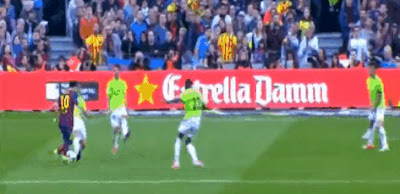
Taking advantage of both defenders reacting, Messi deftly redirects the ball with his right foot...

...and squeezes it between them.
Messi follows the ball, but then makes himself big and slows, knowing if a defender eager to chase him down from behind bowls him over, Barca will be awarded a penalty kick.
A look at the big picture gives a clue at Messi's true objective.
Messi moves to position himself in front of goal and leaves the ball for Iniesta to receive.
The three defenders that were collapsing on Messi moments ago are now completely irrelevant.
Iniesta maximizes his options by pressing toward the goal-line.
Iniesta prudently decides to slip the ball back to Messi.
Messi swings his deadly left foot toward goal.
But only nudges it into his right foot.
The ball bounces back to under Messi's left foot, which he reloads with eye-blinking speed as the defender, reacting to what he expected to be a strike, falls to the ground.
This time Messi does crush the ball, at point blank range, into the net.
FC Barcelona is almost always exceptional at exploiting spaces, but they sometimes forget how disrupting little things like switching positions on the pitch can be. Barca is going to have to remain inventive in order to win the treble this year....

Lionel Messi (#10), whose normal area of the pitch is just above the penalty box on the offensive right side, has drifted over to the left corner of the penalty area. The second-to-last defender has gotten too deep, allowing Alexis Sanchez (#9) to be on-side in front of the goal.

The defense, busy with Iniesta and Sanchez, seems surprised to find Messi on the left. Even the announcer in the commentary from which these screen shots were taken initially states Iniesta's pass is back to Alba.

Three defenders dash toward Messi as he pushes the ball forward, leaving Iniesta all kinds of space on the offensive left.

A defender attempts a tackle (a technique for dispossessing the ball from an opponent)...

...but Messi swiftly moves the ball around the threat with his left foot. The backing defender puts his foot up in case Messi attempts a shot toward goal.
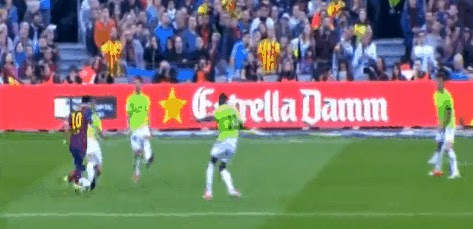
Taking advantage of both defenders reacting, Messi deftly redirects the ball with his right foot...

...and squeezes it between them.

Messi follows the ball, but then makes himself big and slows, knowing if a defender eager to chase him down from behind bowls him over, Barca will be awarded a penalty kick.

A look at the big picture gives a clue at Messi's true objective.

Messi moves to position himself in front of goal and leaves the ball for Iniesta to receive.

The three defenders that were collapsing on Messi moments ago are now completely irrelevant.

Iniesta maximizes his options by pressing toward the goal-line.

Iniesta prudently decides to slip the ball back to Messi.

Messi swings his deadly left foot toward goal.

But only nudges it into his right foot.

The ball bounces back to under Messi's left foot, which he reloads with eye-blinking speed as the defender, reacting to what he expected to be a strike, falls to the ground.

This time Messi does crush the ball, at point blank range, into the net.

FC Barcelona is almost always exceptional at exploiting spaces, but they sometimes forget how disrupting little things like switching positions on the pitch can be. Barca is going to have to remain inventive in order to win the treble this year....
Sunday, March 9, 2014
FC Barcelona Messi Skill Breakdown 2013-4 La Liga Week 26
Football Club Barcelona have earned a direct free kick near the center of the pitch, about 28 yards from goal. As usual, the left-footed Lionel Messi (#10) and right-footed Xavi Hernandez (#6) line up so that either might take the kick. (I have superimposed a line indicating the straight course from the ball to goal.) Adriano (#21) breaks toward the left wing, and the way Messi is lined up, it is possible that he may intend on playing a give-and-go with Adriano:

Messi quickly approaches and strikes the ball with power. The defender abandons Adriano, as it is already clear by the pace of the shot that this isn't a pass:

The balls easily clears the last defender in the wall, several feet wide of the goalkeeper's right post:

Shortly thereafter, the ball abruptly reverses course and curls back towards the goal:

The goalkeeper does his best to react...:

but the ball finds the top corner of the goal, impossibly out of reach and yet exactly aligned with the direct route:

¡Visca el Barca!

Messi quickly approaches and strikes the ball with power. The defender abandons Adriano, as it is already clear by the pace of the shot that this isn't a pass:

The balls easily clears the last defender in the wall, several feet wide of the goalkeeper's right post:

Shortly thereafter, the ball abruptly reverses course and curls back towards the goal:

The goalkeeper does his best to react...:

but the ball finds the top corner of the goal, impossibly out of reach and yet exactly aligned with the direct route:

¡Visca el Barca!
Wednesday, February 26, 2014
Portland, Part III
One day, I answered a call from an unrecognized number. “Heeey, this is Jake Fennell. Remember me?” Of course I did. We had been both bandmates and roommates back in the 90’s. Last I knew, he had run off to Colorado with some chick named Jen. “I just got off the phone with Carl, and he says you live in Portland now. I’m moving there, too! Do you think you could maybe pick me up at the train station in two hours?” Of course I could. It was great to see him.
Jake moved into a nice little apartment near downtown, across the street from the Trader Joe’s Tyler worked at. Tyler had been a mainstay at Tuna Tuesdays. When Tyler’s friend Colin returned from Canada to get his things out of storage and move into an apartment, I was somehow summoned to help, presumably because I was the only person anyone knew who owned a truck. I hadn’t met Colin before, but when the first several boxes in his storage unit consisted of Philip K. Dick books, original screenplays and manuscripts for graphic novels, I knew we’d get along well.
I bought a used bicycle and began riding it on weekends, which sounds like a very Portland-y thing to do- except I bought an 18-speed mountain bike instead of a single-speed road bike with no brakes. A trail near my apartment went through a disc golf course, which is a game I’d enjoyed playing in the late ‘90’s. I bought three discs and went there to play, but gave up when the course became un-navigable. Fortunately, Jeremy knew the course and soon we would be playing a round or two almost every weekend.
By and large, Portlanders liked to stay active but didn’t follow sports, excepting the Trailblazers. There were several kickball leagues consisting of co-eds on a softball field, drinking cans of PBR and asking each other what the rules were. They passionately disdained baseball. Perhaps it was because they had never witnessed Tim Wakefield hurling a knuckler or Barry Bonds crushing a ball. Once I was living alone I started going to Portland Beavers Triple-A baseball games. I often went alone, but had a whole slew of friends and acquaintances, of which one or two would sometimes join me. Despite the nicely laid out stadium and respectable team, the stands remained mostly empty. Eventually, nearly every home game became a routine of filling a flask of whisky and taking the train to the ballpark. After doing some internet research, I taught myself how to keep score, probably as a way of keeping myself company.
I caught wind that a couple friends (or maybe it was just Jim) would be watching a soccer match at a soccer-themed tavern the morning of May 6th, 2009, which seemed as good a way as any to start my birthday. I was familiar with the bar but had only been there on quiet evenings. I doubt I had ever seen an entire soccer match before, but back when I lived in Oakland, I had taken to watching soccer highlight videos, and at that time the greatest showman in the sport was Ronaldinho playing for FC Barcelona in Spain. I was also aware of this specific team because my family had an exchange student from Spain live with us when I was in 11th grade. He had explained to me the politics of Spanish “futbal.” He went for the team that represented Spanish Nationalism and was against the one that strove for equal recognition of minority ethnicities in Spain. This was ingrained in my memory because it had been a fascinating experience of someone trying to convince me of something and succeeding in convincing me of the exact opposite.
As I had become convinced Portlanders hated watching all sports other than basketball, I was surprised by the scene of rabid Chelsea fans. But I secretly and silently rooted for FC Barcelona in this Champions League semi-final, whatever that was…. Unfortunately, Chelsea take an early lead. Barcelona seem to be kicking the ball a lot, but never at the net. After a Barcelona player is shown a red card, they have to play the rest of the match with one less player, but instead of giving up, as the match nears the end, it becomes more and more frenzied. Somehow, if Barcelona can score a tying goal, that would mean they would win. (Two-legged ties and away goals were useless jargon to me, especially since that “tie” doesn’t refer to a draw.) Adding to my confusion, the match keeps going after time is up, and then Andrés Iniesta unexpectedly launches a ball that flies into the net like a heat-seeking missile. I found myself jumping out of my seat with a cry, and then felt the collective glares of a sardine-packed bar upon me. It was akin to being introduced to boxing via “the rumble in the jungle” or hockey by “the miracle on ice.” Despite that fact that I understood even less of what had happened than the (horrible) referee in that match, at that moment, I became a culé. (FC Barcelona would go on to beat Manchester United in the finals.)
I’m pretty sure I spent the rest of that day, like many others that spring, applying reflective tape to a 15 foot diameter geodesic dome Jake had built for his MFA final project.
I began going to Portland Timbers soccer matches, primarily with Colin. The Timbers played in the same stadium as the Beavers baseball team, but it was a completely different scene. Fans packed the place, screaming chants, banging drums and throwing streamers and smoke bombs when they scored. A lumberjack in the midst of the crowd wielded an actual chainsaw which he used to cut discs from a log to pass around the crowd. I also began going to watch women’s soccer matches at the University of Portland, one of the best female teams in the country, with Mike and Janaé. In 2010, I watched the entirety of every single World Cup match, thanks to espn3.com. Iniesta scored the winning goal in that one, too.
Incidentally, soccer would indirectly mean that 2010 would prove to be the last year for the Beavers AAA baseball team. The following year, the Timbers would become part of MLS’s primary division (an honor you have to earn on the pitch in Europe). A condition of that promotion is they needed their own stadium, but instead of building one they decided to try and move the Beavers somewhere else. The public made sure this “waste of money” would not occur. I, on the other hand, wrote the mayor stating I would move out of town if the Beavers weren’t there. That last season was special, because I met and beginning sitting with Geri and Sheila, who had been regularly attending games for years and years. Away players would say “hi” to them on their way to the batter’s box, which we sat right behind and could talk to them as they stretched.
I became involved with a Scotch tasting group that met once a month in the suburbs and began hosting various types of cocktail samplers at my place. But, for the most part, baseball and soccer away games or off-nights were spent experimenting with cocktails while watching Japanese movies and anime, especially after Jake moved to Seattle. I did remain friends with a girl he had dated named Janine, and we would occasionally cook dinner, go out to eat or watching movies with her son. Looking back, I’m realizing those evenings were perhaps the only times I wasn’t drinking. This was a direct result of me having been drinking too much the first few times we had met.
Those that were there will be chuckling that I have left out all of the dumb stuff that I did during my last couple years in Portland. (Well, that’s assuming the things I’ve written about aren’t dumb, which reminds me of a time someone attempted to insult both Portland and me by saying, “If you like drinking whisky at baseball games I can see why you like it here.”) But even while I was still somewhat hurt and angry about Rachel leaving, I was learning to embrace and discover the opportunities within the unforeseen and even unwanted randomness life sometimes forces upon us. Things not working out as desired make it possible for things to work out better than imagined, and only requires a willingness to adapt. This concept is perfectly illustrated by the Chinese game called Mahjong, which I had been introduced to in the Bay Area and had been teaching anybody willing to learn during my five years in Portland. This was why I had local artist Peter Archer tattoo my left upper arm with 18 random Mahjong tiles blowing in the wind. In August of 2010, I got rid of whatever didn’t fit into a rental SUV and moved away.
Jake moved into a nice little apartment near downtown, across the street from the Trader Joe’s Tyler worked at. Tyler had been a mainstay at Tuna Tuesdays. When Tyler’s friend Colin returned from Canada to get his things out of storage and move into an apartment, I was somehow summoned to help, presumably because I was the only person anyone knew who owned a truck. I hadn’t met Colin before, but when the first several boxes in his storage unit consisted of Philip K. Dick books, original screenplays and manuscripts for graphic novels, I knew we’d get along well.
I bought a used bicycle and began riding it on weekends, which sounds like a very Portland-y thing to do- except I bought an 18-speed mountain bike instead of a single-speed road bike with no brakes. A trail near my apartment went through a disc golf course, which is a game I’d enjoyed playing in the late ‘90’s. I bought three discs and went there to play, but gave up when the course became un-navigable. Fortunately, Jeremy knew the course and soon we would be playing a round or two almost every weekend.
By and large, Portlanders liked to stay active but didn’t follow sports, excepting the Trailblazers. There were several kickball leagues consisting of co-eds on a softball field, drinking cans of PBR and asking each other what the rules were. They passionately disdained baseball. Perhaps it was because they had never witnessed Tim Wakefield hurling a knuckler or Barry Bonds crushing a ball. Once I was living alone I started going to Portland Beavers Triple-A baseball games. I often went alone, but had a whole slew of friends and acquaintances, of which one or two would sometimes join me. Despite the nicely laid out stadium and respectable team, the stands remained mostly empty. Eventually, nearly every home game became a routine of filling a flask of whisky and taking the train to the ballpark. After doing some internet research, I taught myself how to keep score, probably as a way of keeping myself company.
I caught wind that a couple friends (or maybe it was just Jim) would be watching a soccer match at a soccer-themed tavern the morning of May 6th, 2009, which seemed as good a way as any to start my birthday. I was familiar with the bar but had only been there on quiet evenings. I doubt I had ever seen an entire soccer match before, but back when I lived in Oakland, I had taken to watching soccer highlight videos, and at that time the greatest showman in the sport was Ronaldinho playing for FC Barcelona in Spain. I was also aware of this specific team because my family had an exchange student from Spain live with us when I was in 11th grade. He had explained to me the politics of Spanish “futbal.” He went for the team that represented Spanish Nationalism and was against the one that strove for equal recognition of minority ethnicities in Spain. This was ingrained in my memory because it had been a fascinating experience of someone trying to convince me of something and succeeding in convincing me of the exact opposite.
As I had become convinced Portlanders hated watching all sports other than basketball, I was surprised by the scene of rabid Chelsea fans. But I secretly and silently rooted for FC Barcelona in this Champions League semi-final, whatever that was…. Unfortunately, Chelsea take an early lead. Barcelona seem to be kicking the ball a lot, but never at the net. After a Barcelona player is shown a red card, they have to play the rest of the match with one less player, but instead of giving up, as the match nears the end, it becomes more and more frenzied. Somehow, if Barcelona can score a tying goal, that would mean they would win. (Two-legged ties and away goals were useless jargon to me, especially since that “tie” doesn’t refer to a draw.) Adding to my confusion, the match keeps going after time is up, and then Andrés Iniesta unexpectedly launches a ball that flies into the net like a heat-seeking missile. I found myself jumping out of my seat with a cry, and then felt the collective glares of a sardine-packed bar upon me. It was akin to being introduced to boxing via “the rumble in the jungle” or hockey by “the miracle on ice.” Despite that fact that I understood even less of what had happened than the (horrible) referee in that match, at that moment, I became a culé. (FC Barcelona would go on to beat Manchester United in the finals.)
I’m pretty sure I spent the rest of that day, like many others that spring, applying reflective tape to a 15 foot diameter geodesic dome Jake had built for his MFA final project.
I began going to Portland Timbers soccer matches, primarily with Colin. The Timbers played in the same stadium as the Beavers baseball team, but it was a completely different scene. Fans packed the place, screaming chants, banging drums and throwing streamers and smoke bombs when they scored. A lumberjack in the midst of the crowd wielded an actual chainsaw which he used to cut discs from a log to pass around the crowd. I also began going to watch women’s soccer matches at the University of Portland, one of the best female teams in the country, with Mike and Janaé. In 2010, I watched the entirety of every single World Cup match, thanks to espn3.com. Iniesta scored the winning goal in that one, too.
Incidentally, soccer would indirectly mean that 2010 would prove to be the last year for the Beavers AAA baseball team. The following year, the Timbers would become part of MLS’s primary division (an honor you have to earn on the pitch in Europe). A condition of that promotion is they needed their own stadium, but instead of building one they decided to try and move the Beavers somewhere else. The public made sure this “waste of money” would not occur. I, on the other hand, wrote the mayor stating I would move out of town if the Beavers weren’t there. That last season was special, because I met and beginning sitting with Geri and Sheila, who had been regularly attending games for years and years. Away players would say “hi” to them on their way to the batter’s box, which we sat right behind and could talk to them as they stretched.
I became involved with a Scotch tasting group that met once a month in the suburbs and began hosting various types of cocktail samplers at my place. But, for the most part, baseball and soccer away games or off-nights were spent experimenting with cocktails while watching Japanese movies and anime, especially after Jake moved to Seattle. I did remain friends with a girl he had dated named Janine, and we would occasionally cook dinner, go out to eat or watching movies with her son. Looking back, I’m realizing those evenings were perhaps the only times I wasn’t drinking. This was a direct result of me having been drinking too much the first few times we had met.
Those that were there will be chuckling that I have left out all of the dumb stuff that I did during my last couple years in Portland. (Well, that’s assuming the things I’ve written about aren’t dumb, which reminds me of a time someone attempted to insult both Portland and me by saying, “If you like drinking whisky at baseball games I can see why you like it here.”) But even while I was still somewhat hurt and angry about Rachel leaving, I was learning to embrace and discover the opportunities within the unforeseen and even unwanted randomness life sometimes forces upon us. Things not working out as desired make it possible for things to work out better than imagined, and only requires a willingness to adapt. This concept is perfectly illustrated by the Chinese game called Mahjong, which I had been introduced to in the Bay Area and had been teaching anybody willing to learn during my five years in Portland. This was why I had local artist Peter Archer tattoo my left upper arm with 18 random Mahjong tiles blowing in the wind. In August of 2010, I got rid of whatever didn’t fit into a rental SUV and moved away.
Friday, February 21, 2014
Portland, Part II
Carl and Ann, Jeremy and Sandy and Rachel and I started meeting up at the Hedge House every Tuesday night to take advantage of the weekly $2.50 pint special offered by all of the Lompoc Brewery destinations. I liked their Sockeye Cream Stout, especially on nitro, but their popular beer was C-Note IPA. The Hedge House was a small, clean place with a nice outdoor area in easy walking distance from where I was living.
Carl and I had met playing hacky-sack and then had been in a couple bands together back in the ‘90’s. The two of us had a great rapport and could riff together effortlessly for hours, both musically and comically. When Jeremy’s dry, understated observations were added to the mix, the shit got over-the-top. Carl would alternate between trying to make Ann laugh and gross her out. It was easy for anybody to make Sandy laugh. I was constantly trying to make Rachel laugh, and was usually successful. She had a boisterous, infectious cackle that softened the cloud of sadness that usually hung over her, especially when she was in Portland. She didn’t want to be in Portland. I think that’s why we went on camping trips as often as we could.
I enjoyed these regular social engagements precisely because I am not a sociable person. A major reason for, or perhaps result of this is that I’ve never gotten the hang of the unwritten rule that you’re generally supposed to do little more than amuse, indulge and placate others in group settings. Once I had a set of friends who understood that whatever I said was probably going to be inappropriate, I didn’t want to waver from them.
That is why it would be sometime before I went to “Tuna Tuesday,” which one of my co-workers, a genuinely quirky girl named Molly, persistently invited me to. Although I’ve heard her explain it several times, I don’t exactly recall the origins of Tuna Tuesday, but think it was a tradition Ted and Molly had inherited several years prior. Molly culled Portland’s art studios and super markets, looking for overly-educated, underpaid 20-somethings to invite over to this BYOB gathering, and Ted and Molly made and served Tuna sandwiches. That was pretty much it.
Neither Rachel nor I knew how to cook, so we worked together figuring it out. We made a lot of pasta dishes, which we paired with every red wine sold at Trader Joe’s. Then we started getting wines, breads and cheeses from a nearby Italian specialty shop, but that quickly got expensive, so we switched to sampling bourbons. Instead of finishing off one bourbon before moving on to the next, we saved the last few ounces until we had five or six that we would drink together with Rachel’s roommates in a blind tasting. On the second such tasting, we were surprised by the winner, so we tried the same bourbons again and a different one was the best- but it was in the same glass that had contained the winner the first time. (We were just using random shot glasses.) So finally, I put the same bourbon in both the winning glass and another, and was quite blown away by the difference the glass made.
Rachel had a roommate who worked as a bartender in a Peruvian restaurant. He spent his days sullying their kitchen with fruity rum-based cocktail combinations. They were too sweet for my palate, but he had several cocktail books lying around, and one day I read one in which each chapter explored both the life of an author and a beverage they are connected with, and it piqued my interest. I ordered a martini at a restaurant, since I’d never tried one before, and it was absolutely disgusting. I intuited that cocktail-making might be a lost art which had led to a public preference for drinks that tasted like Kool-Aid, and began buying and experimenting with cocktail-making ingredients, apparatus and glassware, reading cocktail books and seeking out competent bartenders to order drinks from.
In the autumn of 2007, Rachel and I moved into the Tuna Tuesday house with Molly, which was not far from both Carl and Ann and Jeremy and Sandy. But while Rachel and I now stayed home to be part of the household festivities on Tuesdays, they went to Fifth Quadrant, which was now the closest, but much less cozy, Lompoc location. Rachel and I began going out to eat every Friday evening.
On one summer Friday in 2008, Rachel didn’t return home from work. I called and asked if we were still planning on going out to eat that night, and she said, “No.” She stopped answering the phone after that. A few weeks later, I moved from the Tuna Tuesday home into my first ever solely occupied apartment, bought a pickup truck (with money granted from my mom) and switched from bourbon to Scotch. Looking back, I think the most important thing I lost when Rachel disappeared was an incentive to be funny.
Carl and I had met playing hacky-sack and then had been in a couple bands together back in the ‘90’s. The two of us had a great rapport and could riff together effortlessly for hours, both musically and comically. When Jeremy’s dry, understated observations were added to the mix, the shit got over-the-top. Carl would alternate between trying to make Ann laugh and gross her out. It was easy for anybody to make Sandy laugh. I was constantly trying to make Rachel laugh, and was usually successful. She had a boisterous, infectious cackle that softened the cloud of sadness that usually hung over her, especially when she was in Portland. She didn’t want to be in Portland. I think that’s why we went on camping trips as often as we could.
I enjoyed these regular social engagements precisely because I am not a sociable person. A major reason for, or perhaps result of this is that I’ve never gotten the hang of the unwritten rule that you’re generally supposed to do little more than amuse, indulge and placate others in group settings. Once I had a set of friends who understood that whatever I said was probably going to be inappropriate, I didn’t want to waver from them.
That is why it would be sometime before I went to “Tuna Tuesday,” which one of my co-workers, a genuinely quirky girl named Molly, persistently invited me to. Although I’ve heard her explain it several times, I don’t exactly recall the origins of Tuna Tuesday, but think it was a tradition Ted and Molly had inherited several years prior. Molly culled Portland’s art studios and super markets, looking for overly-educated, underpaid 20-somethings to invite over to this BYOB gathering, and Ted and Molly made and served Tuna sandwiches. That was pretty much it.
Neither Rachel nor I knew how to cook, so we worked together figuring it out. We made a lot of pasta dishes, which we paired with every red wine sold at Trader Joe’s. Then we started getting wines, breads and cheeses from a nearby Italian specialty shop, but that quickly got expensive, so we switched to sampling bourbons. Instead of finishing off one bourbon before moving on to the next, we saved the last few ounces until we had five or six that we would drink together with Rachel’s roommates in a blind tasting. On the second such tasting, we were surprised by the winner, so we tried the same bourbons again and a different one was the best- but it was in the same glass that had contained the winner the first time. (We were just using random shot glasses.) So finally, I put the same bourbon in both the winning glass and another, and was quite blown away by the difference the glass made.
Rachel had a roommate who worked as a bartender in a Peruvian restaurant. He spent his days sullying their kitchen with fruity rum-based cocktail combinations. They were too sweet for my palate, but he had several cocktail books lying around, and one day I read one in which each chapter explored both the life of an author and a beverage they are connected with, and it piqued my interest. I ordered a martini at a restaurant, since I’d never tried one before, and it was absolutely disgusting. I intuited that cocktail-making might be a lost art which had led to a public preference for drinks that tasted like Kool-Aid, and began buying and experimenting with cocktail-making ingredients, apparatus and glassware, reading cocktail books and seeking out competent bartenders to order drinks from.
In the autumn of 2007, Rachel and I moved into the Tuna Tuesday house with Molly, which was not far from both Carl and Ann and Jeremy and Sandy. But while Rachel and I now stayed home to be part of the household festivities on Tuesdays, they went to Fifth Quadrant, which was now the closest, but much less cozy, Lompoc location. Rachel and I began going out to eat every Friday evening.
On one summer Friday in 2008, Rachel didn’t return home from work. I called and asked if we were still planning on going out to eat that night, and she said, “No.” She stopped answering the phone after that. A few weeks later, I moved from the Tuna Tuesday home into my first ever solely occupied apartment, bought a pickup truck (with money granted from my mom) and switched from bourbon to Scotch. Looking back, I think the most important thing I lost when Rachel disappeared was an incentive to be funny.
Monday, February 17, 2014
Portland, Part I
My reasons for moving to Portland, Oregon on Halloween of 2005 were fairly simple: I knew people there, it was on the west coast and I needed to get out of the San Francisco Bay Area rat race. My primary goal upon arriving in Portland was to entrench myself in the local experimental music scene. I was both excited and confident in the development of my personal musical vision that had been formed over five years of intensive listening, practice and performance while in the Bay Area, which offered an atmosphere of many talented, educated and/or veteran musicians hungry to discover sonic potentialities, both improvised and compositional. Upwards of a hundred of us bounced between several underground clubs, aggressively pushing boundaries and challenging conventions. We intentionally tortured our instruments with alternate tunings, techniques and all manner of objects. We liked things fractured, microtonal and transitory.
Among the first people I met in Portland, at a competent music performance I attended the Friday after my arrival, was a welcoming girl named Whitney. She was taking money at the door. I paid in loose change representing, very literally, the last of my life’s savings. When I mentioned I was a drummer and new in town, she invited me to play along as atmospheric accompaniment for a contact dance group on Monday night. I didn’t know what contact dance was, but it proved an interesting opportunity to explore percussive textures and ambiences. Afterwards, Whitney invited me to join a housewarming party at the yurt she was moving into on the outskirts of town. Yep- a yurt. It was actually in a sheep pasture, and you had to be wary of the ram on the walk in.
Whitney had said she was going to spend that day hiking a trail near her novel dwelling and anyone was free to join her, but I was the only person that showed up for that. We talked about our somewhat sympathetic, somewhat divergent plans for the future as we walked. Whitney was never shy about voicing her views but also listened respectfully to my overly-opinionated opinions. She was focused, but didn’t take herself seriously. I never worried about offending her and vice versa. After the walk, a group of around a dozen or so gathered in the yurt and we spent the evening eating snacks, stoking the wood fire and playing the card game “Mafia.” It was one of the best nights I would ever spend in Portland, and it was my second weekend there….
Not long after, I attended a gathering in a warehouse featuring a cast of musicians and dancers in a continuous 12 hour performance, perhaps to celebrate the winter solstice, although I don’t exactly recall. The possibilities in exploration and experimentation over such a long period promised to bring out the best in what Portland musicians had to offer. Instead, they just spent the seven hours I was there playing un-interactive atmospheric whole tones. My approach would have been to drain all of my energy into the music and then find a way to keep going; theirs was to conserve as much energy as possible. I suppose they were envisioning a meditation on understatement and simplicity, but I found it absolutely appalling.
The bulk of the “fringe” musicians in Portland were either into contemporary hip-hop like Kanye West or late 19th and 20th Century French Classical composers such as Messiaen and Saint-Saens. (There was also a strong interest in Indian Classical music, which I adore, but the pretentiousness of those who attended such events was through the roof.) Portlanders preferred pure tones, rustic melodies and soothing harmonies. It soon became evident that nobody was interested in my musical vision, which was heavily influenced by mid 20th century European improv., spearheaded by the likes of Peter Brotzmann, Evan Parker and Alexander von Schlippenbach. To the uninitiated, it sounds like noise, and indeed the musicians I encountered who attempted pure improv. did so by simply making noise, which I found infuriating and they observed to be pointless.
I decided to take things into my own hands and developed a monthly class introducing improvisational music concepts, expanding on a project I had curated at a venue in Oakland before it got turned into a parking lot. I held these workshops, thanks to Noah Mickens, in one of the surprisingly few performance venues in town. It lasted for about four sessions, and then Noah was fired as the promoter for that club.
I was invited to participate as part of a series of duet performances organized by Tim DuRoche, who was essentially the only jazz drummer in town and also someone familiar with the Bay Area scene. I had continued to join and play along with Whitney and the other contact dancers every Monday, and chose one of them to be the other half of my duet. I think Whitney was a bit miffed I didn’t choose her, but her dancing style was hip, elegant and suave, whereas the girl I wanted to work with was intense, abrupt and somewhat bipolar. Because Music and Dance by Derek Bailey and Min Tanaka is one of those pieces that had profoundly affected me about five years prior, I was very keen on the prospect, and indeed I thought our performance was fantastic.
Playing music is controlling an avalanche of moments in time. I endeavored to pour my entire being into each one of those moments. There were times when I felt this task had been successful to the point that I’d feel as I’d become detached from my body or begin seeing the music as colors or creatures, and whenever that occurred, I sort of had this anticipation, when the music finally stopped, that the entire universe would have been somehow radically changed. Perhaps the audience would be so alight with epiphanies they’d begin floating toward the ceiling or something. Instead, in California anyway, these moments would be met with polite applause. In Portland, they were met with the audience politely asking each other if there was any way to politely remove themselves from earshot as quickly as possible.
After the duet performance, the dancer said she was not interested in doing any other work together. I contacted and played with every musician whose name and number I could get a hold of, but nothing developed. I played several times with a girl who sang with an almost-absurd child-like voice, and finally she explained she was looking for a drummer like the one that played for Neutral Milk Hotel. After listening to one of their albums, I suggested she should find a young, inexperienced drummer enthusiastic about showing off the one lick they had learned, and she did.
In the meanwhile, I had quickly acquired a job a few blocks from the room-share where I lived, at a UPS Store. It was a really dumb job and I had to work weekend. Despite that, I kept a busy social life that first winter in Portland, due to Whitney always including me on various group excursions. I would not realize how novel being sociable during the winter was in Portland until later. Also, the weekend work was relatively fun because the managers weren’t there and my co-workers were often just Rachel and Cole, and the three of us got along famously.
Whitney was originally from Illinois, and I don’t even think she had been in Portland very long, but because she was the first person I met there, she had completely skewed my perception of the so-called City of Roses. In the spring, she moved away and joined a successful dance troupe based in New York City. I stopped going to the Monday night contact dance thing and gave up looking for musicians to play with. I finished up a manual on drumming insights that I had begun shortly after moving to the Bay Area back in 2000. For many years now, music had been more important to me than life itself. It seemed now that all music was good for was making me delusional. It was time to change that paradigm, and learn to enjoy living.
Rachel and I decided we should get jobs where we had the weekends free. After doing so, we spent the summer camping in the various environments offered throughout Oregon and Washington. It was sublime.
Among the first people I met in Portland, at a competent music performance I attended the Friday after my arrival, was a welcoming girl named Whitney. She was taking money at the door. I paid in loose change representing, very literally, the last of my life’s savings. When I mentioned I was a drummer and new in town, she invited me to play along as atmospheric accompaniment for a contact dance group on Monday night. I didn’t know what contact dance was, but it proved an interesting opportunity to explore percussive textures and ambiences. Afterwards, Whitney invited me to join a housewarming party at the yurt she was moving into on the outskirts of town. Yep- a yurt. It was actually in a sheep pasture, and you had to be wary of the ram on the walk in.
Whitney had said she was going to spend that day hiking a trail near her novel dwelling and anyone was free to join her, but I was the only person that showed up for that. We talked about our somewhat sympathetic, somewhat divergent plans for the future as we walked. Whitney was never shy about voicing her views but also listened respectfully to my overly-opinionated opinions. She was focused, but didn’t take herself seriously. I never worried about offending her and vice versa. After the walk, a group of around a dozen or so gathered in the yurt and we spent the evening eating snacks, stoking the wood fire and playing the card game “Mafia.” It was one of the best nights I would ever spend in Portland, and it was my second weekend there….
Not long after, I attended a gathering in a warehouse featuring a cast of musicians and dancers in a continuous 12 hour performance, perhaps to celebrate the winter solstice, although I don’t exactly recall. The possibilities in exploration and experimentation over such a long period promised to bring out the best in what Portland musicians had to offer. Instead, they just spent the seven hours I was there playing un-interactive atmospheric whole tones. My approach would have been to drain all of my energy into the music and then find a way to keep going; theirs was to conserve as much energy as possible. I suppose they were envisioning a meditation on understatement and simplicity, but I found it absolutely appalling.
The bulk of the “fringe” musicians in Portland were either into contemporary hip-hop like Kanye West or late 19th and 20th Century French Classical composers such as Messiaen and Saint-Saens. (There was also a strong interest in Indian Classical music, which I adore, but the pretentiousness of those who attended such events was through the roof.) Portlanders preferred pure tones, rustic melodies and soothing harmonies. It soon became evident that nobody was interested in my musical vision, which was heavily influenced by mid 20th century European improv., spearheaded by the likes of Peter Brotzmann, Evan Parker and Alexander von Schlippenbach. To the uninitiated, it sounds like noise, and indeed the musicians I encountered who attempted pure improv. did so by simply making noise, which I found infuriating and they observed to be pointless.
I decided to take things into my own hands and developed a monthly class introducing improvisational music concepts, expanding on a project I had curated at a venue in Oakland before it got turned into a parking lot. I held these workshops, thanks to Noah Mickens, in one of the surprisingly few performance venues in town. It lasted for about four sessions, and then Noah was fired as the promoter for that club.
I was invited to participate as part of a series of duet performances organized by Tim DuRoche, who was essentially the only jazz drummer in town and also someone familiar with the Bay Area scene. I had continued to join and play along with Whitney and the other contact dancers every Monday, and chose one of them to be the other half of my duet. I think Whitney was a bit miffed I didn’t choose her, but her dancing style was hip, elegant and suave, whereas the girl I wanted to work with was intense, abrupt and somewhat bipolar. Because Music and Dance by Derek Bailey and Min Tanaka is one of those pieces that had profoundly affected me about five years prior, I was very keen on the prospect, and indeed I thought our performance was fantastic.
Playing music is controlling an avalanche of moments in time. I endeavored to pour my entire being into each one of those moments. There were times when I felt this task had been successful to the point that I’d feel as I’d become detached from my body or begin seeing the music as colors or creatures, and whenever that occurred, I sort of had this anticipation, when the music finally stopped, that the entire universe would have been somehow radically changed. Perhaps the audience would be so alight with epiphanies they’d begin floating toward the ceiling or something. Instead, in California anyway, these moments would be met with polite applause. In Portland, they were met with the audience politely asking each other if there was any way to politely remove themselves from earshot as quickly as possible.
After the duet performance, the dancer said she was not interested in doing any other work together. I contacted and played with every musician whose name and number I could get a hold of, but nothing developed. I played several times with a girl who sang with an almost-absurd child-like voice, and finally she explained she was looking for a drummer like the one that played for Neutral Milk Hotel. After listening to one of their albums, I suggested she should find a young, inexperienced drummer enthusiastic about showing off the one lick they had learned, and she did.
In the meanwhile, I had quickly acquired a job a few blocks from the room-share where I lived, at a UPS Store. It was a really dumb job and I had to work weekend. Despite that, I kept a busy social life that first winter in Portland, due to Whitney always including me on various group excursions. I would not realize how novel being sociable during the winter was in Portland until later. Also, the weekend work was relatively fun because the managers weren’t there and my co-workers were often just Rachel and Cole, and the three of us got along famously.
Whitney was originally from Illinois, and I don’t even think she had been in Portland very long, but because she was the first person I met there, she had completely skewed my perception of the so-called City of Roses. In the spring, she moved away and joined a successful dance troupe based in New York City. I stopped going to the Monday night contact dance thing and gave up looking for musicians to play with. I finished up a manual on drumming insights that I had begun shortly after moving to the Bay Area back in 2000. For many years now, music had been more important to me than life itself. It seemed now that all music was good for was making me delusional. It was time to change that paradigm, and learn to enjoy living.
Rachel and I decided we should get jobs where we had the weekends free. After doing so, we spent the summer camping in the various environments offered throughout Oregon and Washington. It was sublime.
Subscribe to:
Posts (Atom)